Mold Remediation Integrated Into Commercial and Multi-Family Envelope Repair Scopes
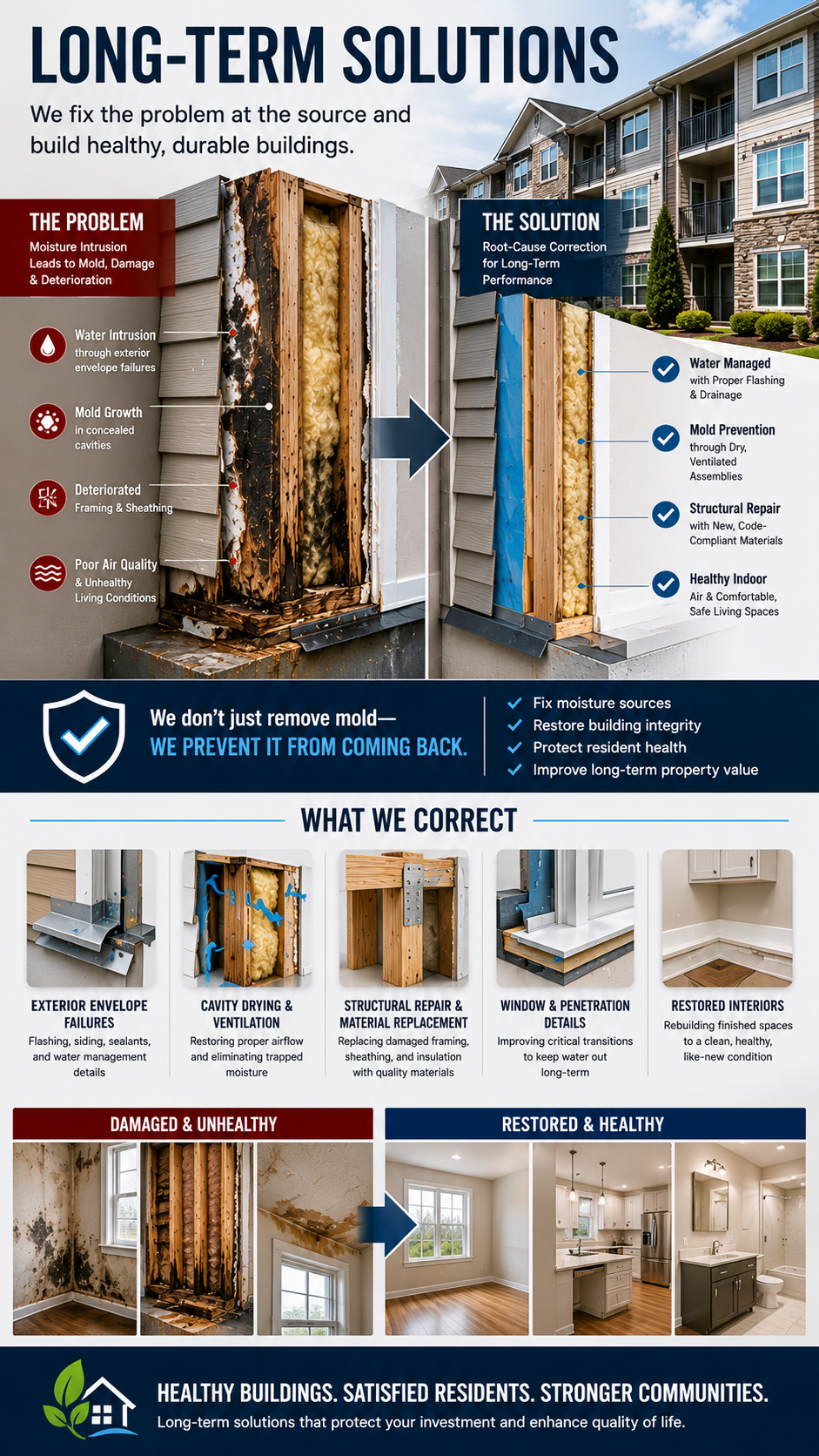
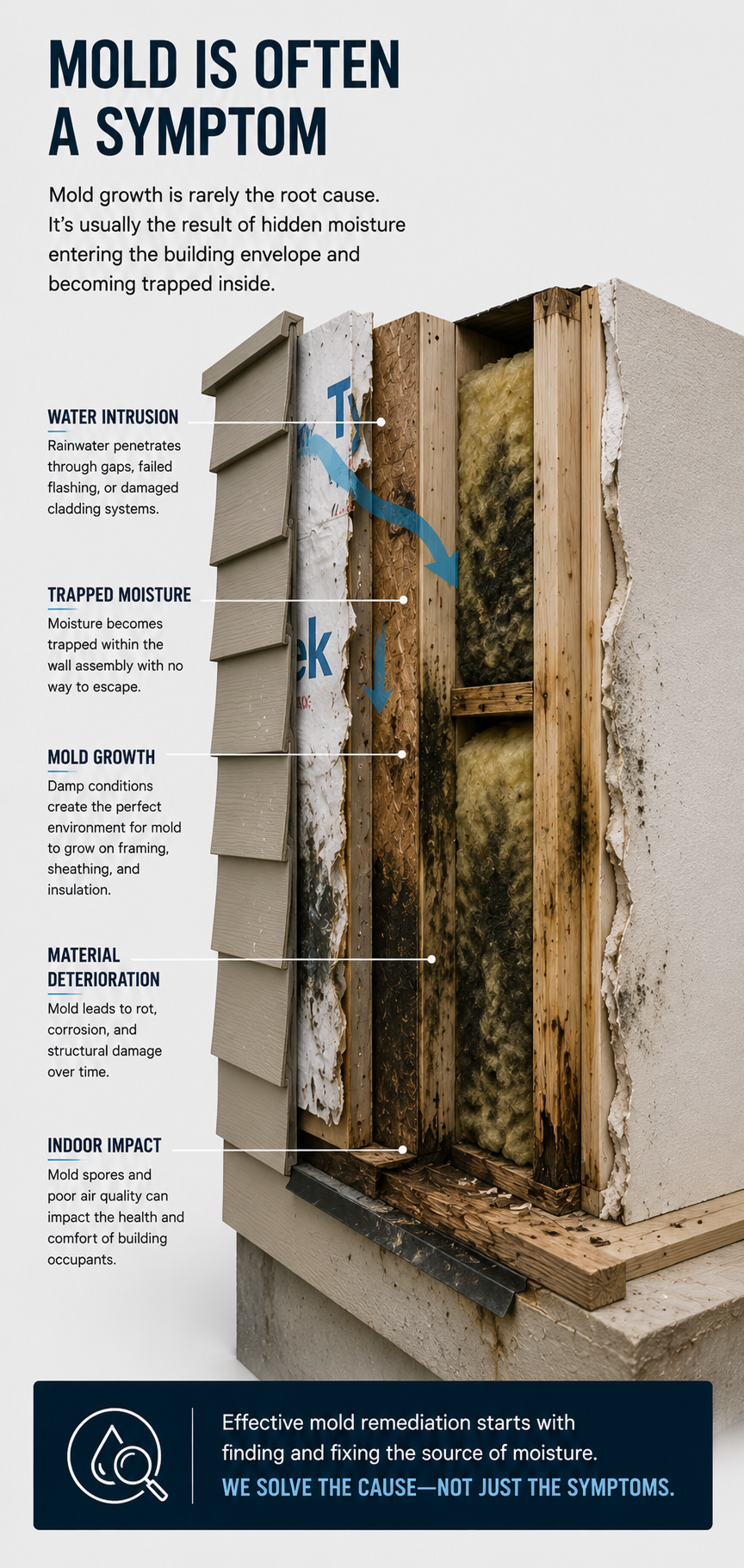
When mold appears in a multi-family or commercial building, it is not a standalone event. It is evidence of a building envelope failure that has been allowing water into the wall assembly long enough for biological growth to establish. The mold is a symptom. The envelope failure is the cause. Pacific Building Solutions is licensed in Oregon (License #215897) and Washington (License #PACIFBS831MK) and has executed mold remediation as an integrated part of exterior envelope repair programs for commercial and multi-family properties throughout the Portland Metro and Southwest Washington region for nearly 30 years.
We do not operate as a standalone mold removal service. We do not respond to individual unit calls, residential homes, or emergency mold events. Our practice is focused on large-scale commercial and multi-family properties where mold has been produced by a building-envelope failure, and where the appropriate response is to remediate the mold, repair the envelope, and document the full scope of work for HOA boards, property managers, construction attorneys, and forensic consultants. If you are dealing with mold that keeps coming back after surface treatment, the reason is almost certainly that the envelope failure producing it has never been addressed. That is exactly the problem we are structured to solve.
Why Mold in Multi-Family Buildings Keeps Coming Back
Surface mold treatment without envelope repair is the most common reason mold returns in multi-family buildings. A restoration company treats the visible mold inside a unit, replaces the damaged drywall, applies a biocide coating, and closes the wall. Six months later, the mold is back. The HOA board schedules another round of unit repairs. The cycle repeats.
The cycle repeats because the water source was never eliminated. In a multi-family building, the water source for mold is almost always the building envelope, not the plumbing. Failed siding, missing flashing, a deteriorated weather barrier, or a window system that has separated from its rough opening is continuously allowing water into the wall cavity. The inside of the wall assembly stays wet. Mold grows in wet wood. Until the envelope failure is identified, repaired, and the wall cavity is allowed to dry, no amount of interior mold treatment will produce a lasting result.
Pacific Building Solutions approaches mold in multi-family buildings by starting on the outside. We identify the water intrusion source in the building envelope, open the wall assembly from the exterior, assess the full extent of biological growth and structural damage, remediate the mold, repair any structural compromise, restore the building envelope, and close the wall with new materials. The interior repair follows the exterior repair. This sequence is the only one that produces a durable result.
What Mold Remediation Integrated Into Envelope Repair Actually Covers
-
Envelope Assessment and Water Source Identification
Before any mold remediation work begins, we identify the building envelope failure that is producing the moisture. We assess the exterior wall assembly and identify failed flashing, deteriorated weather barriers, siding failures, and window or door system failures that allow water into the wall cavity. Remediating mold without this step first produces exactly the repeating mold cycle that most multi-family properties in our service area are already experiencing. The assessment findings are documented for property managers, HOA boards, and legal oversight teams.
-
Controlled Opening and Extent Assessment
Once the exterior water source is identified, we open the wall assembly from the outside under controlled conditions. We assess the full vertical and horizontal extent of biological growth and structural compromise before scoping the remediation work. Mold in multi-family wall assemblies frequently travels along framing members and sheathing well beyond the visible surface staining inside the unit. Opening the wall from the exterior allows us to trace the full extent of growth without creating cross-contamination pathways through occupied interior spaces.
-
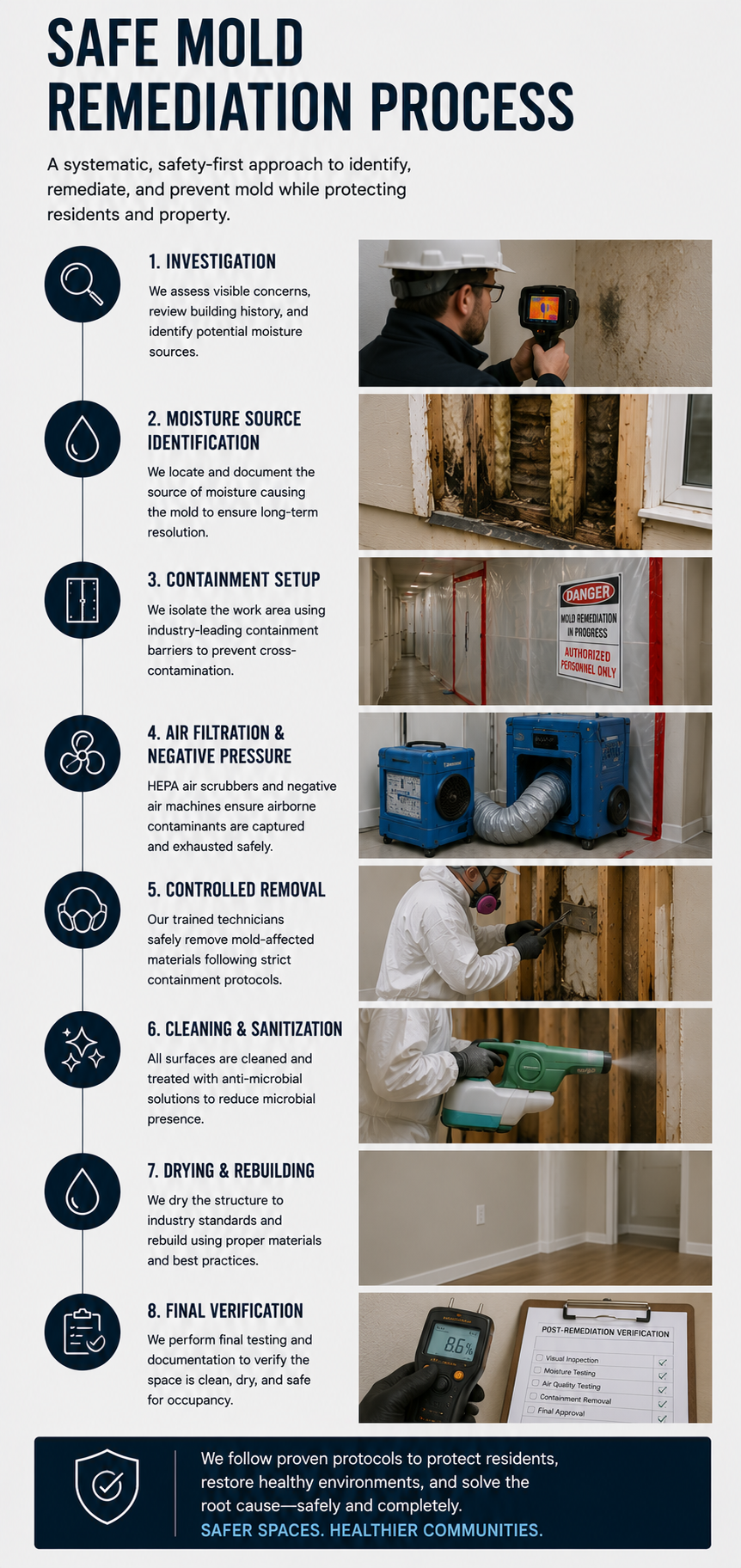
Mold Remediation and Contaminated Material Removal
We remove all contaminated materials, including deteriorated sheathing, affected framing members, and any insulation or building paper compromised by biological growth. Contaminated materials are contained and disposed of in accordance with applicable regulations. We do not encapsulate mold in place behind new materials. Encapsulation without removal is a deferred problem, not a remediation. In a construction defect or legal oversight environment, encapsulation without documentation of removal creates liability that HOA boards and property managers do not need.
-
Structural Repair at the Framing and Sheathing Level
Sustained water intrusion and biological growth in multi-family wall assemblies frequently result in structural compromise at the rim joist, bottom plate, stud, and sheathing levels. We assess and repair structural damage within the same scope as the mold remediation and envelope repair. Passing structural repair to a separate contractor after mold remediation creates scheduling gaps, coordination overhead, and an unnecessary window of weather exposure when the work is properly sequenced under a single contractor.
-
Weather Barrier and Drainage Plane Restoration
After mold remediation and structural repair, the wall cavity is allowed to dry before new materials are installed. We then restore the weather-resistive barrier and drainage plane with current-standard materials and installation practices. This step is what separates a durable repair from a temporary one. A properly installed weather barrier and drainage plane is the primary defense against future water intrusion and the future mold growth it would produce.
-
Siding Replacement and Envelope Closure
With the weather barrier restored, we install replacement siding using James Hardie fiber cement, Cedar, Craneboard, or Stucco/EIFS as appropriate to the building type and the specifications of the property manager, HOA board, or forensic consultant overseeing the scope. New siding is integrated with restored flashing details and the repaired weather barrier to produce a complete, warrantable exterior assembly. The wall is now properly closed for the first time since the original construction defect or maintenance failure.
Who Calls Us About Mold in Multi-Family and Commercial Buildings
Mold Remediation in the Pacific Northwest Multi-Family Context
The Portland Metro and Southwest Washington region’s climate creates specific and persistent mold risk for multi-family building envelopes that is worth understanding before scoping any remediation program. The region’s sustained wet seasons produce months of low-intensity rainfall that keeps building envelopes under continuous moisture pressure. Unlike regions where heavy but short rain events allow building assemblies to dry between exposures, the Pacific Northwest keeps envelopes wet for extended periods. Any gap in the weather protection of a multi-family building allows water to enter and accumulate in the wall cavity throughout that period.
The construction practices common in Pacific Northwest multi-family development from the 1970s through the 1990s compounded this risk. Weather barriers were frequently omitted or improperly installed. Flashing details at windows, doors, deck ledgers, and roof-to-wall transitions were often incomplete or absent. LP Outer-Seal siding, widely installed during that period, is a documented failure product that absorbs moisture and deteriorates from the inside out. Multi-family properties built during those decades that have not had their building envelopes fully remediated are, in most cases, carrying active water intrusion pathways that are producing ongoing biological growth in the wall assembly, regardless of how many times individual units have been treated.