Structural Repair Related to Envelope Failure in Multi-Family and Commercial Buildings
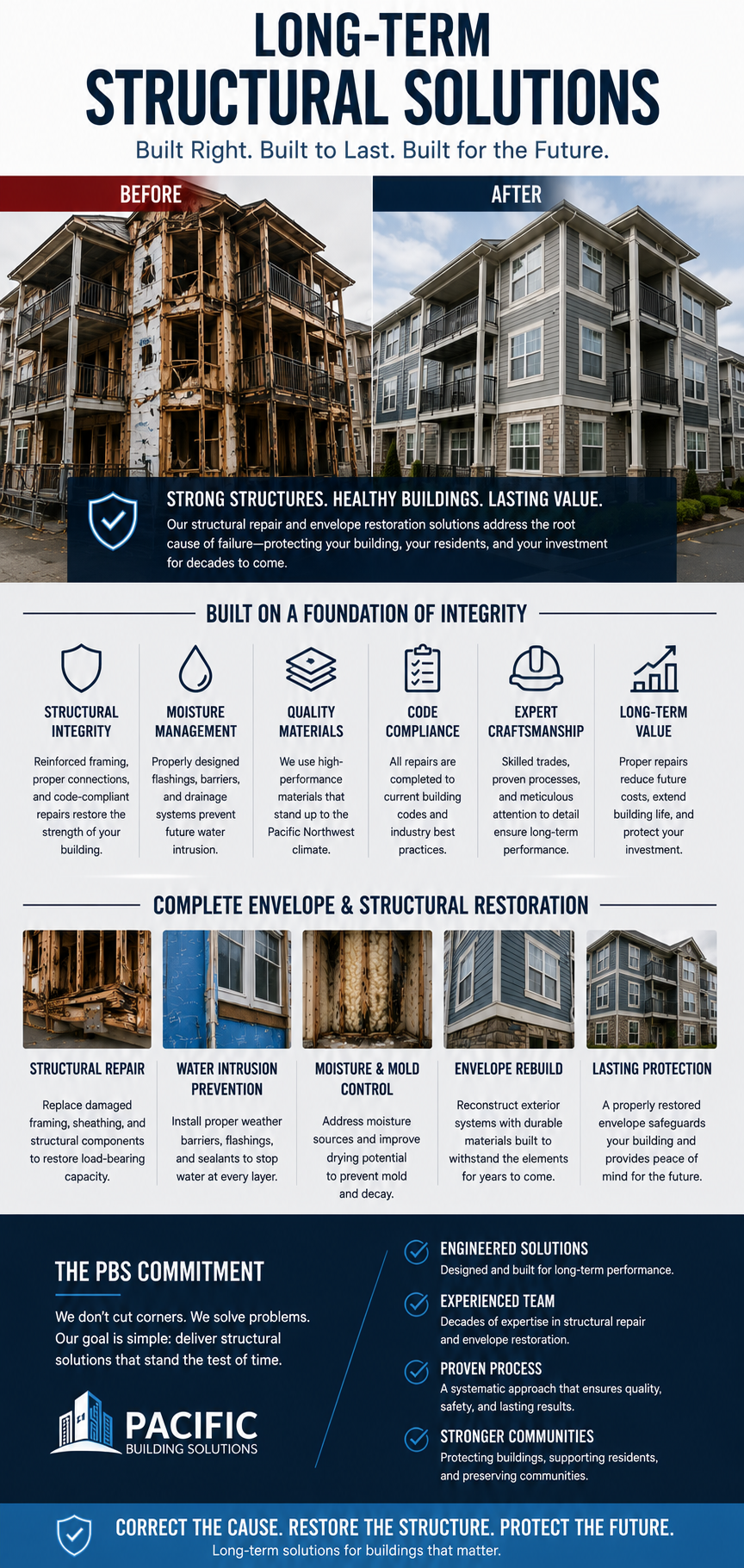
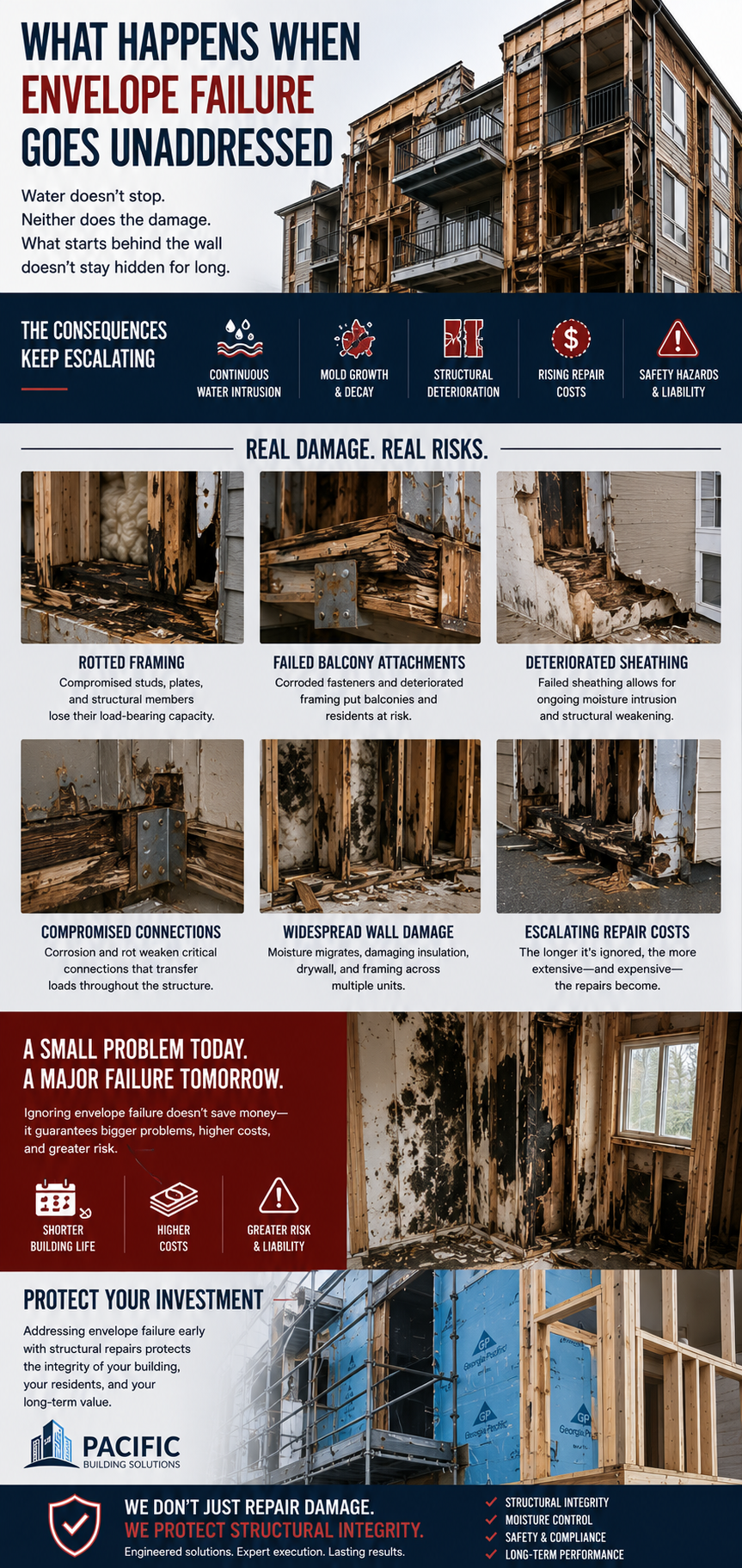
Structural damage in a multi-family or commercial building is almost never the original problem. It is what happens when a building envelope failure goes unaddressed long enough for water to reach the framing. Rim joist deterioration, bottom plate failure, sheathing delamination, and stud damage are not construction accidents. They are the predictable outcome of sustained water intrusion through failed siding, missing flashing, or a deteriorated weather barrier that was never repaired. Pacific Building Solutions is licensed in Oregon (License #215897) and Washington (License #PACIFBS831MK) and has assessed and repaired structural damage related to envelope failure in multi-family and commercial properties throughout the Portland Metro and Southwest Washington region for nearly 30 years.
We do not perform general structural contracting, foundation work, or seismic upgrades. Our structural repair practice is specifically focused on the damage caused by building envelope failures in the exterior wall assemblies of multi-family and commercial properties. If you are an HOA board, property manager, construction attorney, or forensic consultant dealing with structural compromise in a building where water intrusion through the exterior envelope is the identified cause, this is what we do. And because we repair the building envelope at the same time, the structural repair we perform is not at risk of failing again from the same source.
Why Structural Damage From Envelope Failure Is Worse Than It Looks
The visible symptoms of envelope-related structural damage in a multi-family building rarely reflect the actual extent of the problem. Interior staining, soft spots in the flooring near exterior walls, and visible mold at the base trim are late-stage signals of a process that has been underway in the wall assembly for months or years before any interior symptoms appear.
By the time an HOA board or property manager identifies a soft floor or a spongy wall at the base of an exterior framing bay, the water has typically been moving through that assembly through a failed water intrusion pathway long enough to produce not just surface staining but wood fiber deterioration, loss of structural section in the rim joist and bottom plate, and in many cases, biological growth throughout the cavity. The structural damage visible at the wall opening is almost always larger than the symptom that prompted the investigation.
This is why structural repair related to envelope failure cannot be scoped accurately from the interior. The repair scope must be defined by opening the wall assembly from the exterior, assessing the full vertical and horizontal extent of deterioration, and then scoping structural repair as part of the same mobilization that repairs the envelope. Attempting to scope structural repair from an interior inspection alone produces repair programs that are consistently undersized and that require a second mobilization when the full extent of damage is revealed during the actual repair work.
What Structural Repair Related to Envelope Failure Actually Covers
-
Exterior Opening and Full-Extent Assessment
We begin every structural repair scope by opening the wall assembly from the exterior, not from the interior. This approach allows us to assess the full vertical and horizontal extent of structural deterioration in the framing cavity before scoping repair quantities. Interior-based assessments of envelope-related structural damage are systematically unreliable because the damage frequently extends above and below the visible symptom and is not accessible from the interior without demolishing finished wall surfaces. Our exterior opening approach produces accurate scope quantities and eliminates the second-mobilization costs associated with under-scoped interior assessments.
-
Rim Joist and Bottom Plate Replacement
Rim joist and bottom plate deterioration are the most common structural findings in envelope failure assessments on Pacific Northwest multi-family construction. These members sit at the base of the exterior wall framing, where water that has penetrated the envelope accumulates before it can drain or evaporate. In buildings with sustained water intrusion, these members can reach full deterioration across multiple framing bays, requiring section-by-section replacement while the building remains occupied and the remaining structure is supported. We execute rim joist and bottom plate replacement as part of the same mobilization as the envelope repair, eliminating the need for a separate structural contractor and a separate project schedule.
-
Stud Repair and Sistering
Stud deterioration from envelope-related water intrusion typically occurs at the base of the framing bay, where water pools before it can escape. When stud damage is limited to the lower portion of the member, we sister new framing alongside the deteriorated section rather than replacing the full stud, preserving the structural connection above and limiting the scope of repair to the damaged zone. When the full stud is compromised, full replacement is required. We assess each framing member individually and document repair decisions for the property manager, HOA board, or legal oversight team.
-
Sheathing Replacement
Structural sheathing that has been saturated by water intrusion loses its structural contribution to the wall diaphragm and provides an ongoing substrate for biological growth if not replaced. We remove and replace deteriorated sheathing as part of the structural repair scope, installing new sheathing panels that are correctly integrated with the new framing and the restored weather barrier. Sheathing replacement is sequenced before weather barrier and siding installation so that the new exterior assembly is built on a sound substrate.
-
Weather Barrier Restoration and Envelope Repair
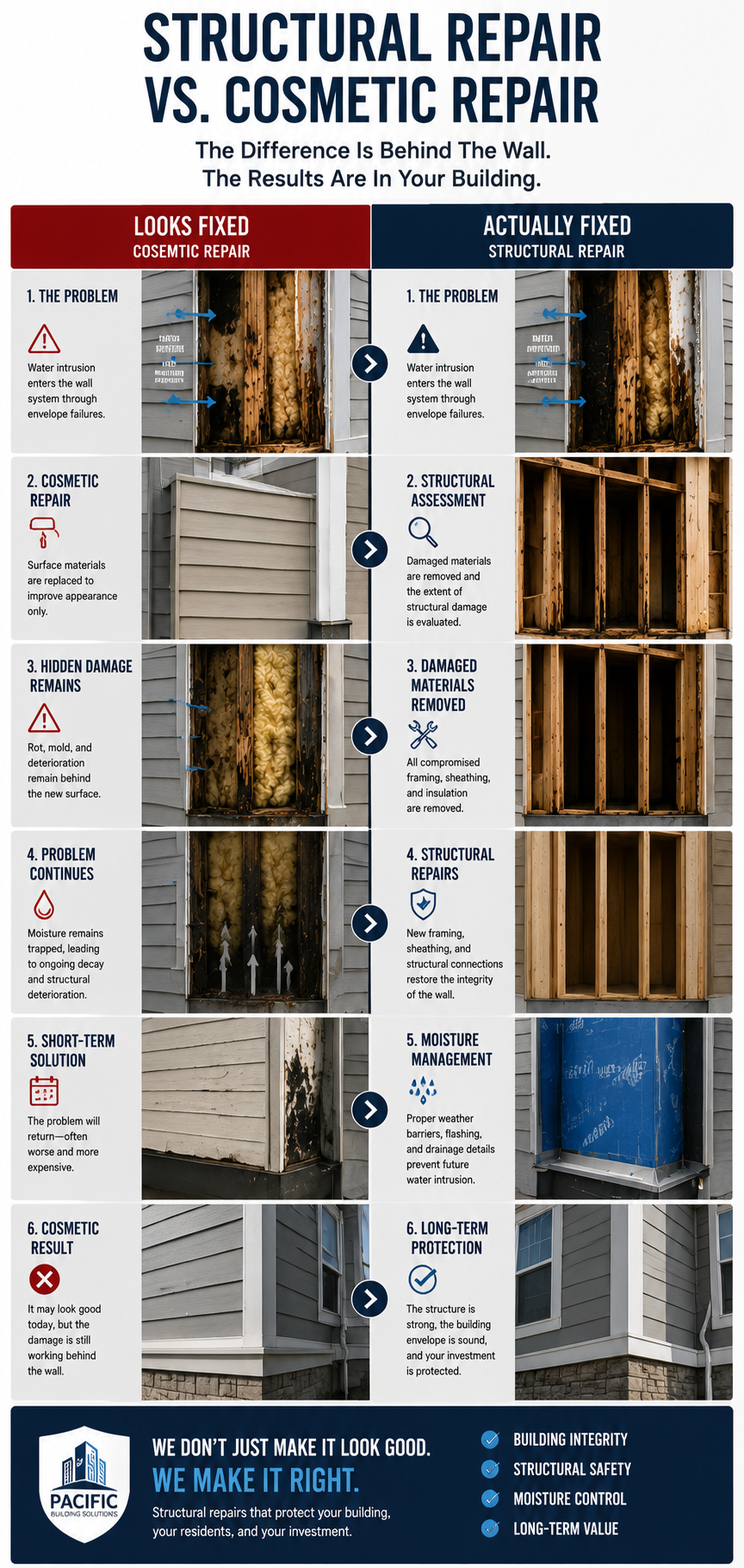
Structural repair without envelope repair produces structural damage again. Once framing and sheathing have been replaced, we restore the weather-resistive barrier and drainage plane with current-standard materials and installation practices, repair or replace all flashing details at windows, doors, penetrations, and transitions, and prepare the wall assembly for siding installation. This step is what makes the structural repair durable, rather than a temporary fix that will need to be repeated in a few years when the same envelope failure reintroduces water to the new framing.
-
Siding Replacement and Envelope Closure
With the structural repair and weather barrier restoration complete, we install replacement siding using James Hardie fiber cement, Cedar, Craneboard, or Stucco/EIFS as appropriate to the building type and the specifications of the property manager, HOA board, or forensic consultant overseeing the scope. The completed assembly, from new framing through new siding, is documented and warrantable as a system. The envelope failure that caused the structural damage has been eliminated, not patched.
Who Calls Us About Structural Damage in Multi-Family Buildings
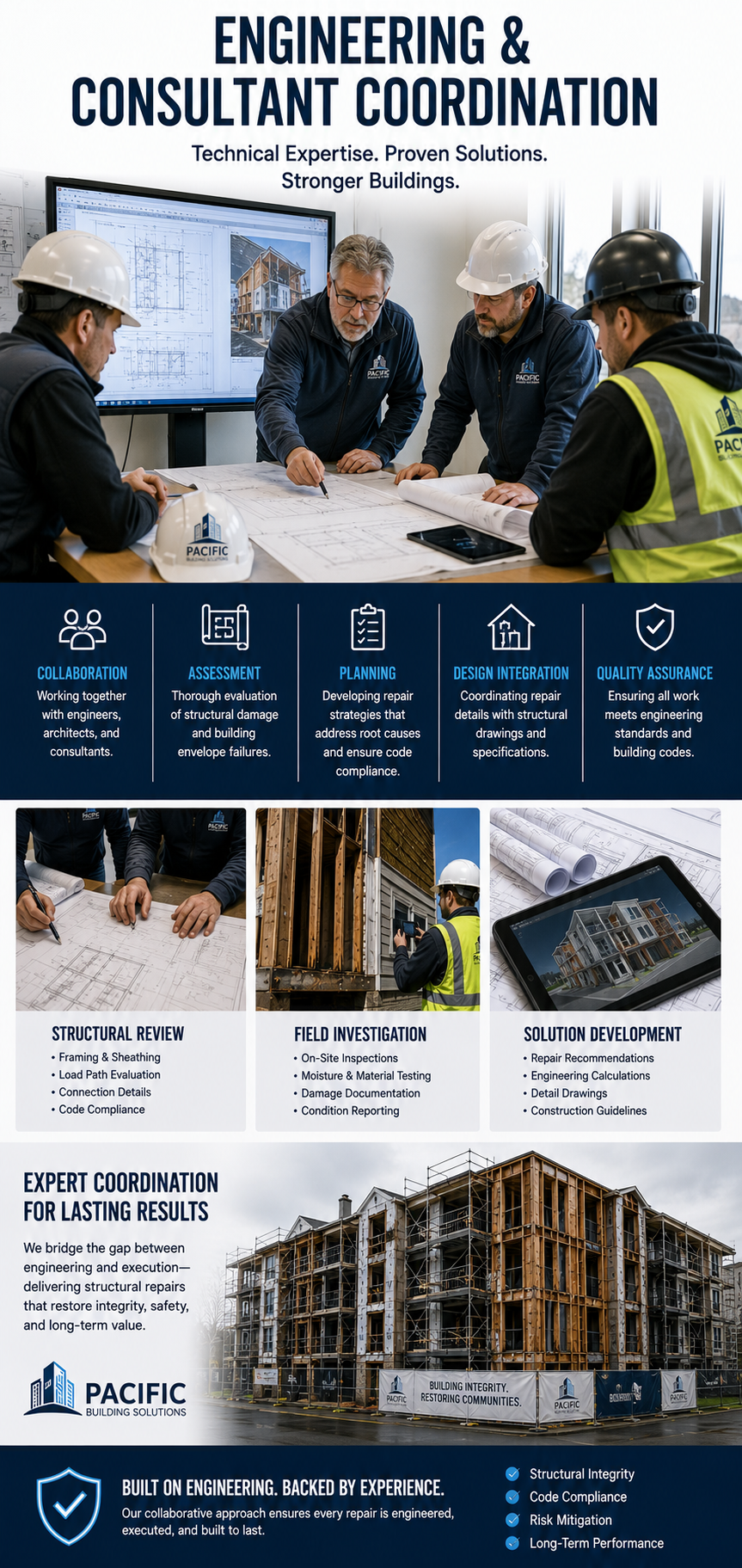
Why Structural Repair and Envelope Repair Must Be the Same Scope
The most expensive structural repair outcome in a multi-family building is a program executed without simultaneous envelope repair. The structural members have been replaced, the wall has been closed, and the building envelope failure that caused the original damage remains. Water continues to enter the wall assembly. The new framing deteriorates. The repair program has to be executed again.
This outcome is more common than it should be because structural and envelope repairs are often treated as separate scopes, managed by separate contractors on separate timelines. A structural contractor repairs the framing. A siding contractor replaces the exterior cladding. The envelope repair happens months later, after the structural contractor has closed the wall and the siding contractor has installed new cladding over the unrepaired weather barrier. The new cladding conceals the continued envelope failure until the new framing begins to deteriorate.
Pacific Building Solutions sequences structural and envelope repairs as a single, integrated scope because they are a single physical problem. We open the wall, assess the damage, repair the structure, restore the weather barrier and flashing, and install new siding in a continuous sequence. The wall is not closed until every element of both the structural and envelope repairs has been completed, inspected, and documented.