Commercial Water Intrusion Repair and System Restoration for Multi-Family and Commercial Properties
Water intrusion is the most common driver of building envelope failure in the Pacific Northwest. It is also the most misunderstood. The entry point, a failed window seal, a deteriorated flashing detail, a siding joint that has separated, is rarely where the damage is worst. By the time water intrusion becomes visible inside a building, it has typically been moving through the wall assembly for months or years, saturating sheathing, degrading structural members, and creating conditions for mold growth that are not apparent from the surface. Pacific Building Solutions is licensed in Oregon (License #215897) and Washington (License #PACIFBS831MK) and has executed water intrusion repair programs for commercial and multi-family properties throughout the Portland Metro and Southwest Washington region for nearly 30 years.
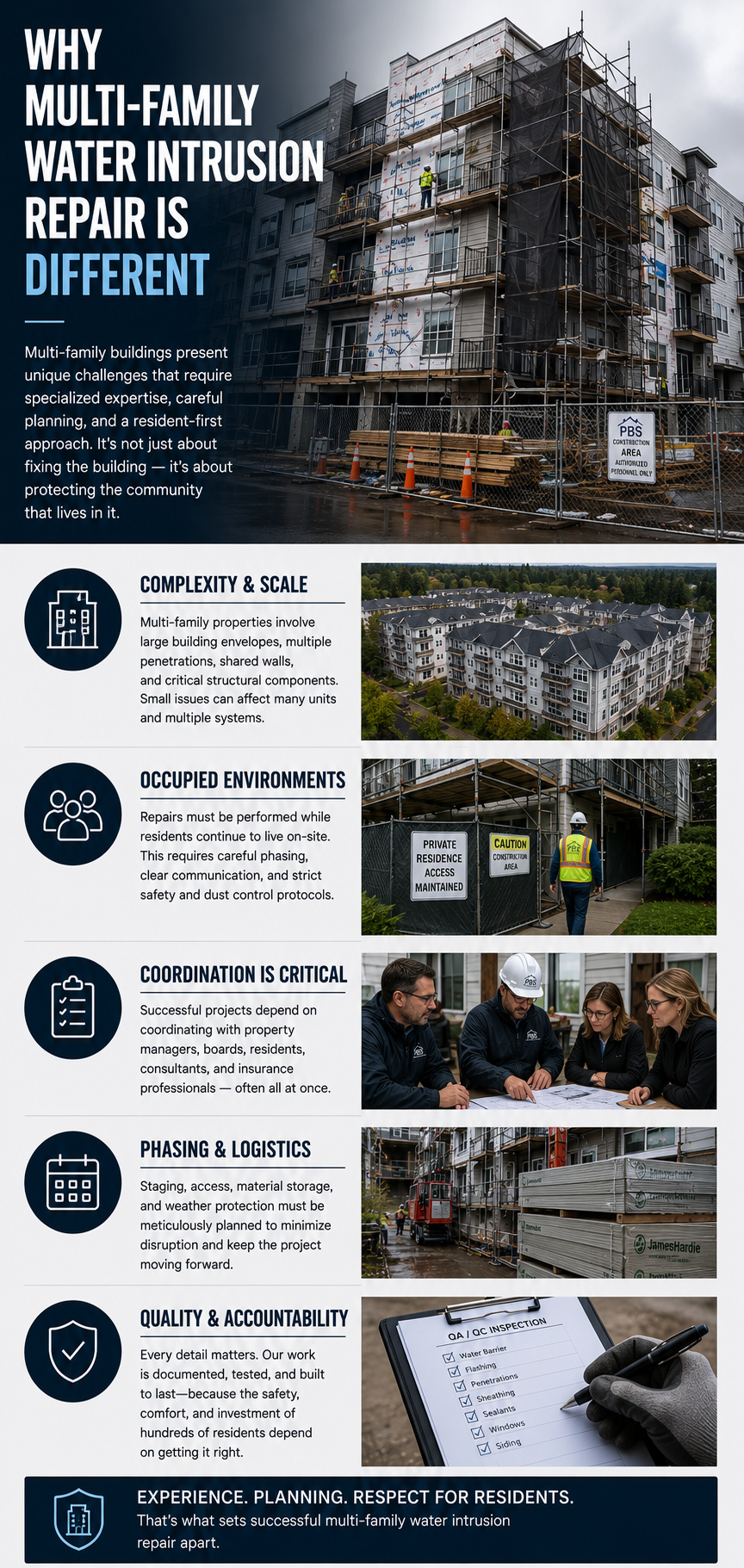
We do not perform emergency water damage restoration or insurance-claim water mitigation for individual units. Our practice is focused on large-scale, system-level water intrusion repair for multi-family apartment communities, condo associations, HOA-governed properties, and commercial buildings where the failure is a building envelope problem, not an isolated plumbing or weather event. If you are an HOA board, property manager, construction attorney, or owner representative dealing with water intrusion across multiple units or building faces, this is what we do.
Why Water Intrusion in Multi-Family Buildings Is a System Problem, Not a Surface Problem
A single source of water intrusion in a multi-family building rarely stays single. The Pacific Northwest’s sustained wet seasons, wind-driven rain events, and the construction practices common in the 1980s and 1990s produce failure patterns that affect the full building section, not just the visible surface. Understanding why requires understanding how water moves through a wall assembly.
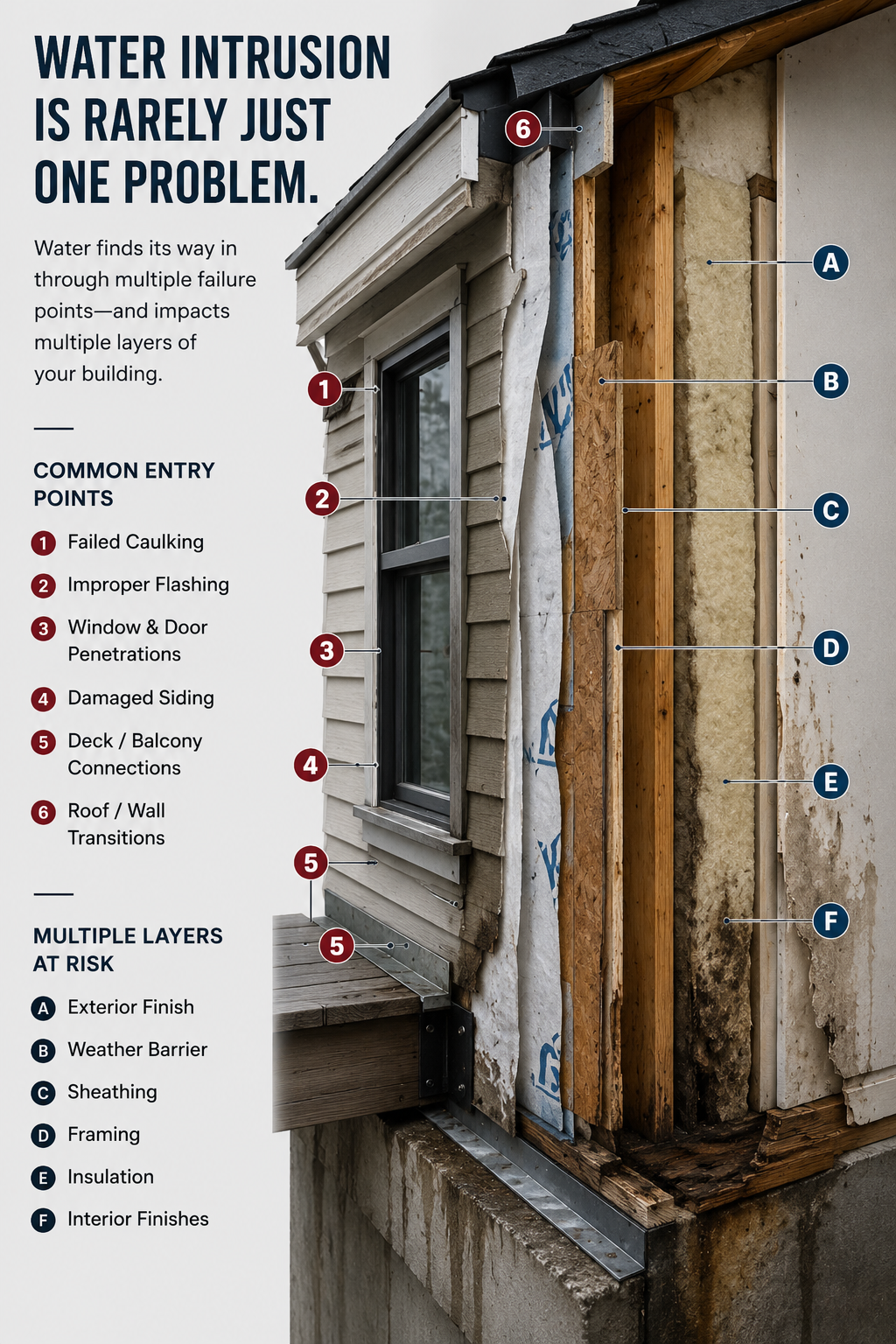
In a properly functioning exterior wall, water that penetrates the outermost cladding layer, siding, stucco, or other cladding is intercepted by a weather-resistive barrier and directed to flashing details that route it back to the exterior. When any element of that system fails, barrier tears, flashing omissions, siding deterioration, or caulk failure at penetrations, water bypasses the drainage plane and enters the structural cavity. Once inside, it saturates wood sheathing, travels along framing members, pools at floor plates, and eventually appears as staining, bubbling paint, soft drywall, or visible mold inside occupied units.
By the time those internal symptoms appear, the scope of repair is almost always larger than the symptoms suggest. Our water intrusion repair process begins with identifying the system-level cause, not just the visible entry point, and scoping repair to address the full extent of the failure.
What Our Water Intrusion Repair Process Covers
-
Envelope System Assessment and Failure Source Identification
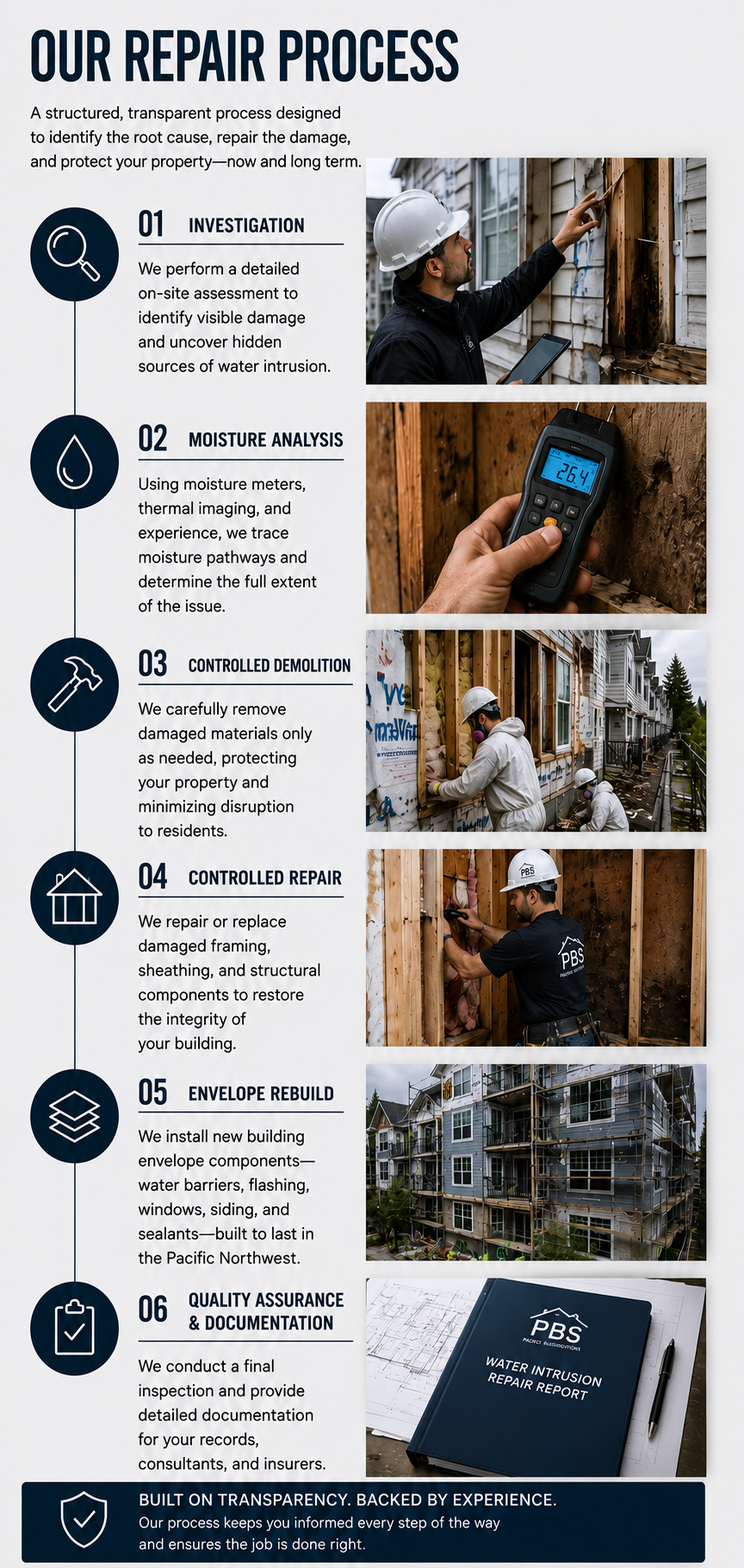
We begin every water intrusion repair scope with a systematic assessment of the building envelope. We identify the failure mechanism (failed flashing, deteriorated weather barrier, cladding system failure, window or door system failure, or penetration failure) and map the full extent of water migration through the wall assembly before scoping any repair work. Assessment findings are documented for property managers, HOA boards, and legal teams as required.
-
Weather Barrier and Drainage Plane Restoration
Restoring the weather-resistive barrier and drainage plane is the foundation of durable water intrusion repair. We remove failed cladding, assess the condition of the underlying barrier, replace damaged sheathing, and install new barrier materials in accordance with current installation standards before installing any new cladding. Skipping or shortcutting this step produces repairs that fail again within a few years.
-
Siding System Replacement and Integration
Water intrusion repair and siding replacement are almost always the same scope in multi-family buildings with envelope system failures. We replace failed siding systems with James Hardie fiber cement, Cedar, Craneboard, or Stucco/EIFS as appropriate, integrating new siding with restored flashing and barrier systems to produce a complete, warrantable exterior assembly.
-
Window and Door System Repair and Replacement
Window and door system failures are among the most common water intrusion entry points in 1980s and 1990s Pacific Northwest construction. Failed sealants, improper head flashing, missing sill pan flashing, and deteriorated frames all allow water to enter through openings. We repair or replace window and door systems as part of water intrusion scopes, ensuring the new systems are correctly integrated with the restored weather barrier and flashing details.
-
Flashing System Repair and Replacement
Flashing failures at roof-to-wall transitions, deck ledgers, window heads, penetrations, and horizontal offsets are the most common single cause of water intrusion in multi-family construction. We identify every failed or missing flashing detail in the assessment phase and replace or install flashing systems as part of the repair scope. Flashing is not an optional upgrade in a water intrusion repair program. It is the repair.
-
Structural Repair Related to Water Damage
Sustained water intrusion frequently produces structural compromise at the rim joist, bottom plate, and sheathing level. We assess and repair structural damage as part of water intrusion scopes rather than passing that element to a separate contractor. Splitting structural repair from envelope repair creates gaps in the repair sequence and adds time and coordination overhead that HOA boards and property managers do not need.
-
Documentation for Legal and Oversight Environments
Water intrusion in multi-family buildings frequently involves insurance claims, construction defect litigation, or forensic consultant oversight. Our documentation protocols (assessment reports, scope documentation, photo records, and repair verification) are structured to satisfy the requirements of attorney oversight, owner representative review, and insurance documentation from the first day of the project through closeout.
Who Calls Us About Water Intrusion in Multi-Family Buildings
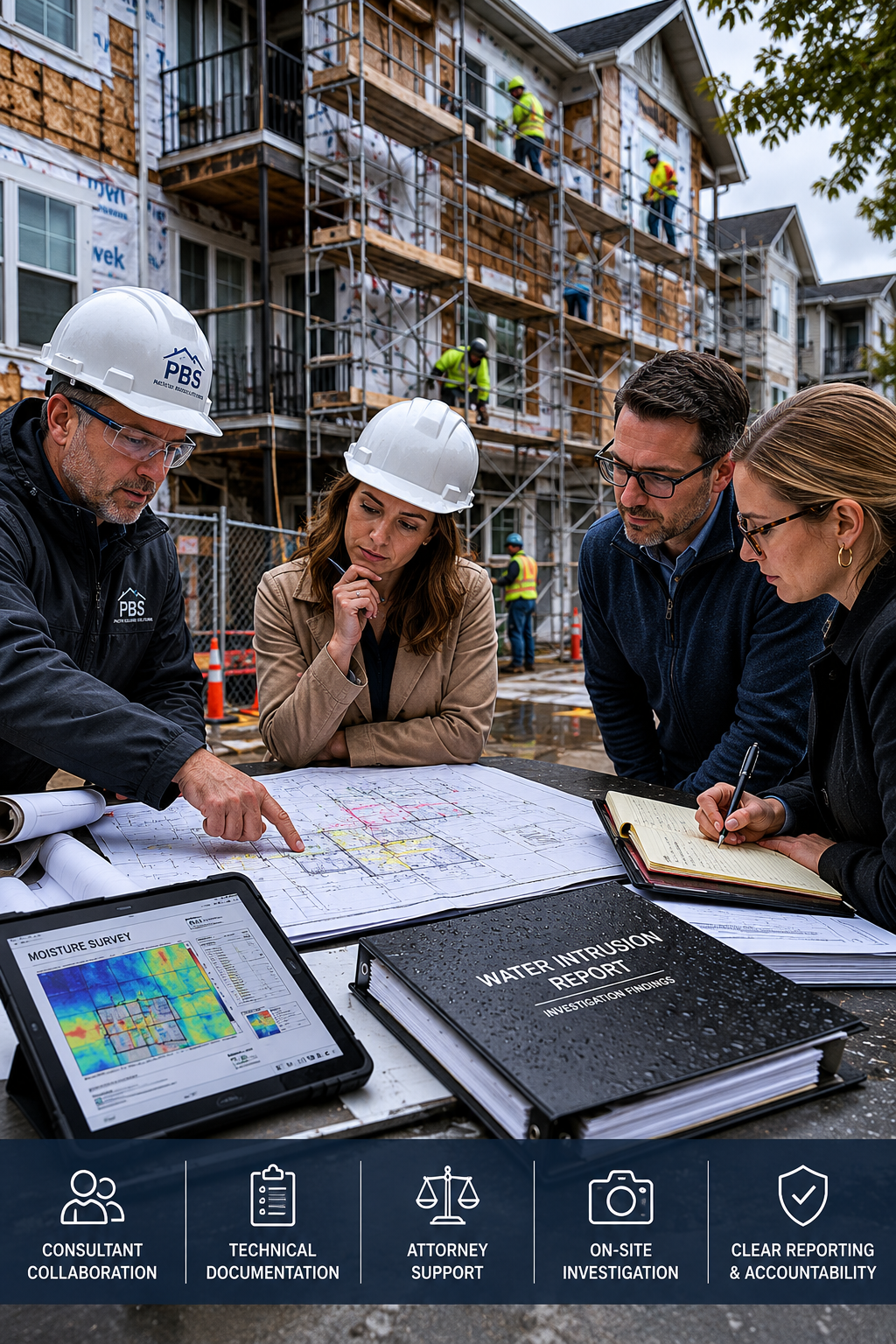
Our water intrusion repair clients are not homeowners dealing with a leak. They are the professionals and institutions responsible for commercial and multi-family properties at scale:
Water Intrusion Repair in the Pacific Northwest
The Portland Metro and Southwest Washington region produce specific water intrusion conditions that are worth understanding before scoping any repair program. The region’s sustained wet seasons, typically October through May, produce months of near-continuous low-intensity rainfall that does not overwhelm building envelopes in a single event but sustains moisture pressure against building assemblies for extended periods. This pattern saturates building envelopes with any gap in their weather protection, keeping them wet and allowing biological growth, wood deterioration, and adhesion failure to proceed continuously rather than in isolated events.
Wind-driven rain events, particularly in the Columbia River Gorge corridor and other exposed locations, add directional moisture loading that can force water through building assemblies that would otherwise handle ambient rainfall without failure. Properties in exposed locations, at higher elevations, or near river corridors face a higher risk of water intrusion than sheltered properties in the same region.
Construction practices common in the 1980s and 1990s, the primary era for most of the multi-family housing stock in our service area, frequently omitted or improperly installed weather barriers, flashing systems, and drainage details that are now standard. The repair needs in the Pacific Northwest are not a future risk. It is a present condition across a large portion of the existing multi-family building inventory.